Future Hardware: AI Architect – Building the Brains of Tomorrow
Quick Overview
- Salary: ₹25-50 LPA
- Qualification: M.Tech/PhD
- Industry: Semiconductor
- Skills: VLSI Design
The Silicon Foundation of Artificial Intelligence
When we talk about the Artificial Intelligence revolution, the conversation often revolves around software—neural networks, algorithms, and massive datasets. But none of these software miracles would be possible without the underlying hardware. The specialized silicon chips that perform trillions of calculations per second are the true engines of AI. Designing these chips is the job of the AI Hardware Architect, a role that stands at the very pinnacle of the engineering world.
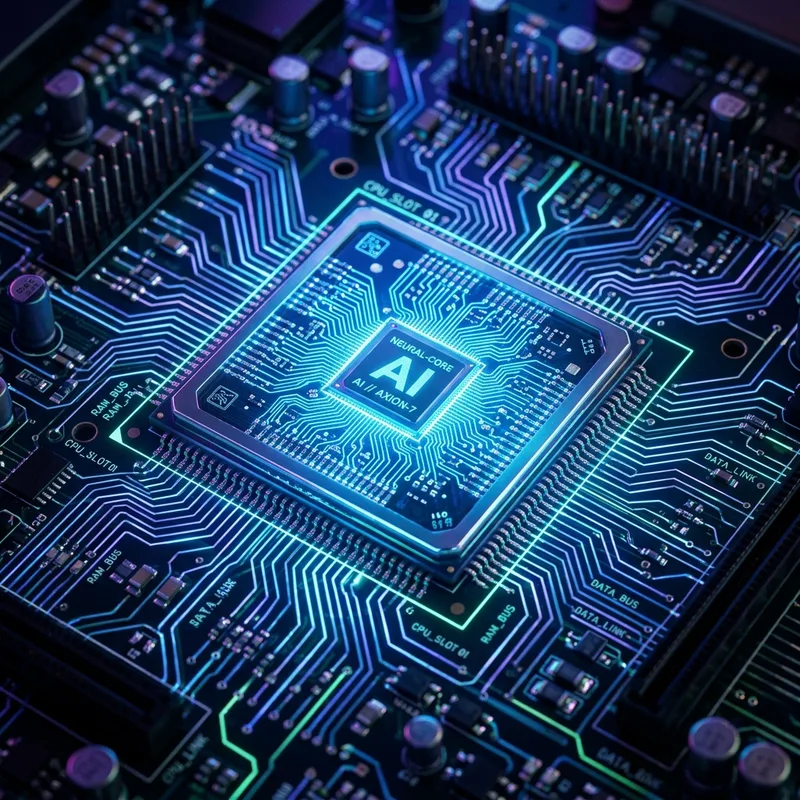
As the demand for computational power grows exponentially, general-purpose processors (CPUs) are no longer sufficient. The future belongs to highly specialized AI accelerators—GPUs, TPUs, and NPUs. AI Hardware Architects are the masterminds who design these silicon brains.
What Does an AI Hardware Architect Do?
An AI Hardware Architect designs microprocessors that are specifically optimized for the mathematical operations required by deep learning (mostly massive matrix multiplications). Their work involves:
Microarchitecture Design: Determining how data flows through the chip, designing memory hierarchies to minimize latency, and creating specialized arithmetic logic units (ALUs) that handle AI workloads with maximum efficiency.
Power and Thermal Management: AI chips run incredibly hot and consume vast amounts of electricity. Architects must innovate ways to maximize performance per watt, which is crucial for both massive data centers and battery-powered mobile devices.
Hardware-Software Co-design: Working closely with software compiler teams to ensure that AI frameworks (like PyTorch and TensorFlow) can run seamlessly and efficiently on the new silicon architecture.
Eligibility and Core Skills
This is arguably the most academically rigorous field in the tech industry. It almost exclusively requires a Master’s degree or Ph.D. in Electronics Engineering, Electrical Engineering, or Computer Engineering, with a heavy focus on VLSI (Very Large Scale Integration) design and Computer Architecture.
Key Skills Required:
- VLSI and RTL Design: Proficiency in hardware description languages like Verilog or VHDL.
- Computer Architecture: Deep knowledge of instruction set architectures (ISA), pipelines, cache coherence, and parallel computing.
- Electronic Design Automation (EDA): Mastery of complex simulation and physical design tools from companies like Synopsys or Cadence.
- Machine Learning Workloads: A solid understanding of how neural networks compute data, to tailor the hardware to the algorithm.
Salary and Compensation
Due to the extreme scarcity of qualified professionals and the critical strategic importance of semiconductors (often referred to as 'the new oil'), AI Hardware Architects command some of the highest salaries in the global economy.
In India's semiconductor hubs (like Bengaluru and Hyderabad), starting salaries for M.Tech/Ph.D. graduates in this niche range from ₹20,00,000 to ₹35,00,000 (20-35 LPA). Senior architects with 10+ years of experience at giants like NVIDIA, AMD, Intel, or Apple earn upwards of ₹70,00,000 to ₹1,50,00,000 (70 LPA - 1.5 Cr) per year in base pay and stock grants. In the US, salaries frequently exceed $400,000.
The Future Demand
The AI hardware race is the most fiercely contested technological battleground of our era. Not only are traditional chipmakers competing, but tech giants like Google (TPU), Amazon (Inferentia), and Tesla (Dojo) are heavily investing in designing their own custom AI silicon. If you have the academic rigor and the passion to push the boundaries of physics and computation, a career as an AI Hardware Architect guarantees a lifetime of fascinating work, unparalleled compensation, and the chance to literally build the future.